Free AI Visibility Checkers and AEO Tools: The Ultimate 2026 List
 Yash Raj
TL;DR: what are the best free AI visibility checkers and AEO tools?
For a free snapshot, use HubSpot's AI Search Grader. For free technical fixes, use the Listable Labs free tools: AI Crawlability Checker, LLMs.txt Generator and Agent Readiness Scanner. Free ongoing tracking is limited to trials and free starts, so use a free start or trial from Listable Labs, Profound or LLMrefs.
Free tools are good at diagnosing, weak at tracking. This list is honest about where each stops.
How we evaluated these free AEO tools
This page is for founders, marketers and SEO leads who want a first read on AI visibility without a budget. We looked at four things:
- What it measures: brand perception, citations, crawlability or technical readiness.
- Which engines it covers: ChatGPT, Gemini, Perplexity, AI Mode, AI Overviews.
- What is missing from the free version: repeat checks, competitors, sources, history.
- Where it leads: a free fix, or a paid step.
Prices and trial terms were checked on vendor pages in October 2026.
Comparison table: free AI visibility and AEO tools at a glance
| Tool | What is free | What free skips | Paid from |
| Listable Labs free tools | 5 technical tools | Visibility tracking | from $89/month |
| Listable Labs platform | Free start, no credit card | Higher prompt and project limits | from $89/month |
| HubSpot AI Search Grader | One-time score, no account | Repeat tracking, sources | $50/month (HubSpot AEO) |
| LLMrefs | Free account, 7-day trial | Full plan limits | $79/month |
| Profound | 7-day trial, 50 prompts daily | Custom prompts, full engines | custom enterprise pricing |
| Semrush | Free AI Visibility Checker, 7-day trial | Continuous tracking | $199/month |
| Ahrefs | Limited free account | Brand Radar AI data | $50/month (Brand Radar) |
| Google Search Console and GA4 | Full | Prompt and answer data | free |
What does "free" actually cover in AEO?
Free AEO tools fall into three groups. Graders give a one-off score. Technical checkers tell you whether engines can read your site. Trials let you run a real tracker for a few days.
None of them replaces ongoing tracking. AI answers change by wording, model and session, so one check proves little. Real measurement needs a fixed set of 40 to 50 buyer prompts run on a schedule, with cited sources and competitors recorded each time.
If you want the full paid landscape, read our guide to the best answer engine optimization tools for 2026.
1. Listable Labs free tools: best free technical AEO fixes
Verdict: the most useful free set for making sure engines can read and trust your site.
Listable Labs publishes five free tools. The AI Crawlability Checker checks whether AI crawlers can reach your pages. The LLMs.txt Generator builds an llms.txt file. The AI Agent Readiness Scanner scores how ready your site is for AI agents. There is also a Robots.txt Generator and an OG Generator.
These tools do not track your brand in answers. They fix the foundation, which is where many brands lose visibility before content even matters.
Best for: anyone starting AEO who wants fixes before spending.
Starting at: free.
2. Listable Labs platform: best free start for real tracking
Verdict: the only option here that moves from a free start to full tracking, citations and actions in one product.
You can start on Listable Labs free with no credit card. The platform tracks ChatGPT, Google Gemini and Google AI Mode on every plan, with Perplexity, Google AI Overviews and Microsoft Copilot as add-ons. It follows an Insights, Actions, Impact loop: visibility, mentions, citations and a competitor benchmark, then a prompt explorer and AI-optimized article generation, then Google Analytics, Search Console, Bing Webmaster Tools and Cloudflare integrations.
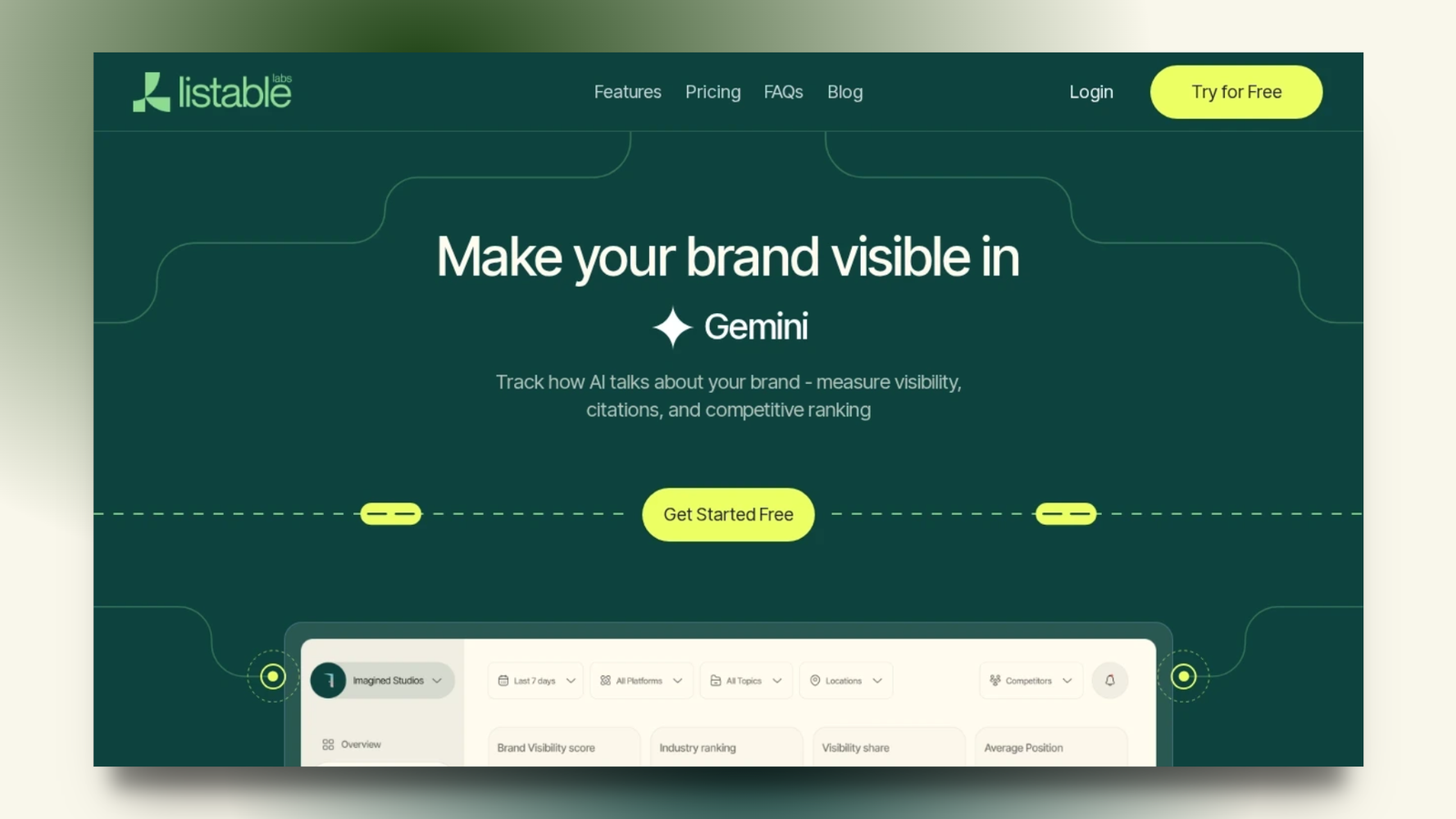
The honest limits: Claude, Grok, Meta AI and DeepSeek are not tracked, and each plan includes 3 models. Paid plans start at $89/month for 1 project, 50 prompts and 4,500 analysed answers. The Listable Labs MCP lets you query results from Claude, ChatGPT or Cursor.
Best for: brands that expect to move past a one-off check.
Starting at: free to start; paid plans from $89/month. See pricing.
3. HubSpot AI Search Grader: best free one-time brand score
Verdict: the fastest free read on how AI describes your brand, with clear limits.
HubSpot's AI Search Grader gives a one-time brand perception score out of 100 across five dimensions. It uses ChatGPT, Perplexity and Gemini and needs no account. The score reflects how the models perceive your brand from training data rather than a live retrieval check, so it will not show which pages are cited today.
HubSpot's paid AEO product is $50/month and tracks weekly across the same three engines.
Best for: a quick baseline and a screenshot for your team.
Starting at: free; $50/month for continuous tracking.
4. LLMrefs: best free account for keyword-based tracking
Verdict: a free account and a low-cost plan that covers every major engine.
LLMrefs offers a free account with no credit card and a 7-day trial. The paid All in One plan is $79/month for 500 prompts across 11 engines, including ChatGPT, AI Mode, AI Overviews, Gemini, Perplexity, Claude and Copilot. It tracks keywords and generates prompts from them. Results refresh at least weekly, not daily. What the free account itself includes was not clear on the pricing page, so test it before relying on it.
Best for: SEOs who think in keywords.
Starting at: free account; $79/month.
5. Profound free trial: best free look at an enterprise tool
Verdict: a real 7-day tracker, but fixed prompts and no self-serve price after.
Profound's free Trial runs 50 prompts daily for 7 days on ChatGPT, Gemini and Google AI Overviews, with limited AI Marketer credits. Trial prompts cannot be customised, so you cannot test your own buyer questions. After the trial, pricing is custom enterprise pricing. Use it to see an enterprise dashboard, not to run your programme.
Best for: enterprise teams evaluating a vendor.
Starting at: free for 7 days; then custom enterprise pricing.
6. Semrush and Ahrefs: what their free options include
Verdict: useful for classic SEO data; AI visibility depth sits behind paid plans.
Semrush offers a free AI Visibility Checker and a site-wide 7-day trial. Paid AI visibility starts with the $199/month Starter plan, which tracks 50 prompts daily across ChatGPT, Perplexity, Gemini, AI Mode and AI Overviews.
Ahrefs does not run free trials. Its free account is limited, while AI data lives in Brand Radar, which starts at $50/month. Both are good for SEO teams that already use them, and neither is a free AEO tracker.
Best for: SEO teams extending a suite they already use.
Starting at: free checker or account; $199/month (Semrush) or $50/month (Ahrefs Brand Radar).
7. Google Search Console, GA4 and Bing Webmaster Tools: best free traffic evidence
Verdict: free, reliable and essential, but they show traffic and impressions, not AI answers.
Google Search Console shows clicks and impressions for your pages in Google Search. Google Analytics 4 shows sessions, and you can filter referral sources to see visits from AI engines. Bing Webmaster Tools adds Bing data. None of them show which prompts named your brand, which competitors were recommended or which sources were cited.
Listable Labs integrates with all three, plus Cloudflare, so you can tie AI visibility to traffic once you track it.
Best for: everyone, as a baseline.
Starting at: free.
What free tools cannot tell you
Four questions need paid tracking. Which sources do engines cite when they recommend a competitor? How often are you named across 50 prompts rather than one? Does your share of voice rise or fall month on month? Did a content change move anything?
A free grader answers none of these, because it runs once and does not store history. That is the line between a diagnosis and a measurement programme.
How to use free tools for a first AI visibility audit
- Fix access: run the free AI Crawlability Checker and generate an llms.txt file.
- Get a baseline: run the HubSpot grader and save the score.
- Write 40 to 50 prompts: category, comparison, use-case and branded questions.
- Test them by hand: ask ChatGPT, Gemini and Perplexity, and record whether you are named and which sources appear.
- Check traffic: compare AI referral sessions in GA4 with Search Console trends.
- Decide on paid: if you repeat step 4 weekly, automate it.
When should you move from free to paid?
Move when manual checking stops being practical or when someone else needs the numbers. That usually means you need scheduled prompt runs, competitor benchmarks and cited sources.
Entry plans: Otterly.ai from $29/month for 15 prompts, Listable Labs from $89 for 50 prompts and 3 engines, Peec AI and Promptwatch from $95. For agencies, the agencies page covers white-label reporting and per-client workspaces.
Final verdict: which free option should you start with?
Start with the free technical checkers, take a HubSpot score for a baseline, then start free on Listable Labs when you want repeat tracking. Free tools tell you where you stand once. A tracker tells you whether you are winning over time. Compare paid options in our guides to AEO tools ranked by value and the 15 best GEO tools, or start free with Listable Labs.
Frequently Asked Questions
Related Articles
15 Best AEO & GEO Tools for AI Search Visibility (2026)
The best GEO tools of 2026, ranked: 15 generative engine optimization platforms with checked prices, engine coverage and honest limits, plus a plain explanation of GEO vs AEO vs SEO.
Best AI Search Visibility Tools 2026 Pricing and Coverage
A price-and-coverage comparison of 18 AI search visibility tools: starting price, engines tracked, prompt limits and the plan caps that change the real cost.
Semrush and Ahrefs AI Visibility vs Dedicated AEO Tools: What We Found After Real Testing (2026)
When is a Semrush or Ahrefs AI-visibility feature enough, and when is a dedicated AEO tool like Listable Labs, Peec or Profound the better buy? Our 2026 testing breaks it down.