15 Best AEO Tools for Ecommerce and D2C Brands in 2026
 Yash Raj
TL;DR: which AEO tools are best for ecommerce and D2C brands?
Listable Labs is the best AEO tool for most ecommerce and D2C brands in 2026: ChatGPT, Gemini and Google AI Mode tracking from $89/month, multi-country tracking for India and the US, a Shopify integration, and citation data showing which review sites and marketplaces shape answers. Goodie AI is the pick for Amazon Rufus tracking, Promptwatch and Rankscale add shopping data, and Otterly.ai is the cheapest start.
Below are 15 AEO tools for ecommerce, with prices and engine lists checked in October 2026.
How AI search changes ecommerce and D2C discovery
Shoppers now ask engines for recommendations: "best protein powder under 2,000 rupees", "best running shoes for flat feet", "X versus Y". The answer names a few products and cites a few sources. If your brand is not in that shortlist, you are not in the consideration set.
Three things decide inclusion for product brands:
- Product page facts: specifications, price, availability, reviews and structured data an engine can quote.
- Third-party corroboration: review sites, listicles, forums and marketplace listings that mention you.
- Prompt fit: whether your pages answer the actual shopping question, not only the brand name.
AEO tools measure this by running shopping prompts repeatedly and recording which brands and sources appear. For the wider category view, see our guide to the best answer engine optimization tools for 2026.
How we evaluated these tools for ecommerce
This list is for ecommerce managers, D2C founders and agencies running product brands. We compared each tool on:
- Shopping coverage: does it track shopping surfaces or only text answers.
- Product and platform fit: Shopify and CMS integrations, content actions for product and category pages.
- Citation data: which marketplaces, review sites and publishers the engines cite.
- Multi-country tracking: India and US prompts tracked separately.
- Price per prompt: D2C teams usually need 40 to 50 prompts across categories.
Prices and engine lists were checked on vendor pricing pages in October 2026. Airefs, which appeared on older lists, no longer has a working site and has been removed.
Comparison table: AEO tools for ecommerce at a glance
| Tool | Starting price | Shopping angle | Best for |
| Listable Labs | from $89/month | Shopify integration, multi-country | D2C brands and agencies |
| Goodie AI | from $399/month | Amazon Rufus and Alexa tracked | Marketplace-heavy brands |
| Promptwatch | from $95/month | Shopping insights on Business ($579) | Tracking plus content agents |
| Rankscale AI | from $99/month | Shopping-card analytics | Credit-based tracking |
| Cognizo | from $499/month | ChatGPT Shopping on Pro ($999) | Content on autopilot |
| Writesonic GEO | from $79/month, billed annually | Shopping on Enterprise | SEO and GEO with a writer |
| GetMint | from EUR 74/month | AI Shopping incl. Amazon and Alexa | EU and French D2C |
| Peec AI | from $95/month | Prompt tracking, any 3 models | SEO teams |
| Otterly.ai | from $29/month | Budget monitoring | Small stores |
| Gauge | from $599/month | High answer volume | Challenger brands |
| Bluefish AI | custom | Alexa for Shopping | Large enterprise |
| Profound | custom enterprise pricing | Up to 9 engines | Enterprise brands |
| Ahrefs Brand Radar | from $50/month | Category-level benchmarking | Ahrefs users |
| Paprik AI | from $49/month, billed annually | Low-cost India vendor | Early-stage founders |
| AI Clicks | from $59/month | 11 engines, managed services | Small teams |
1. Listable Labs: best overall for ecommerce and D2C
Verdict: the best balance of tracking, citations and publishing for product brands, with India and US coverage.
Listable Labs is an AI search visibility and AEO platform built in Bengaluru for India, US and global brands. It follows an Insights, Actions, Impact loop. Insights covers visibility, mentions, citations, share of voice and a competitor benchmark, so you see which review sites, listicles and marketplaces engines cite for your category. Actions covers a prompt explorer, a knowledge base for product facts, AI-optimized article generation with review steps, social content for Reddit, LinkedIn, YouTube and Instagram, and auto-publish.
Shopify is among the integrations on all plans, next to WordPress, Webflow and Sanity. Multi-country tracking lets you compare India and US prompts separately. Impact connects Google Analytics, Search Console, Bing Webmaster Tools and Cloudflare so you can tie visibility to traffic.
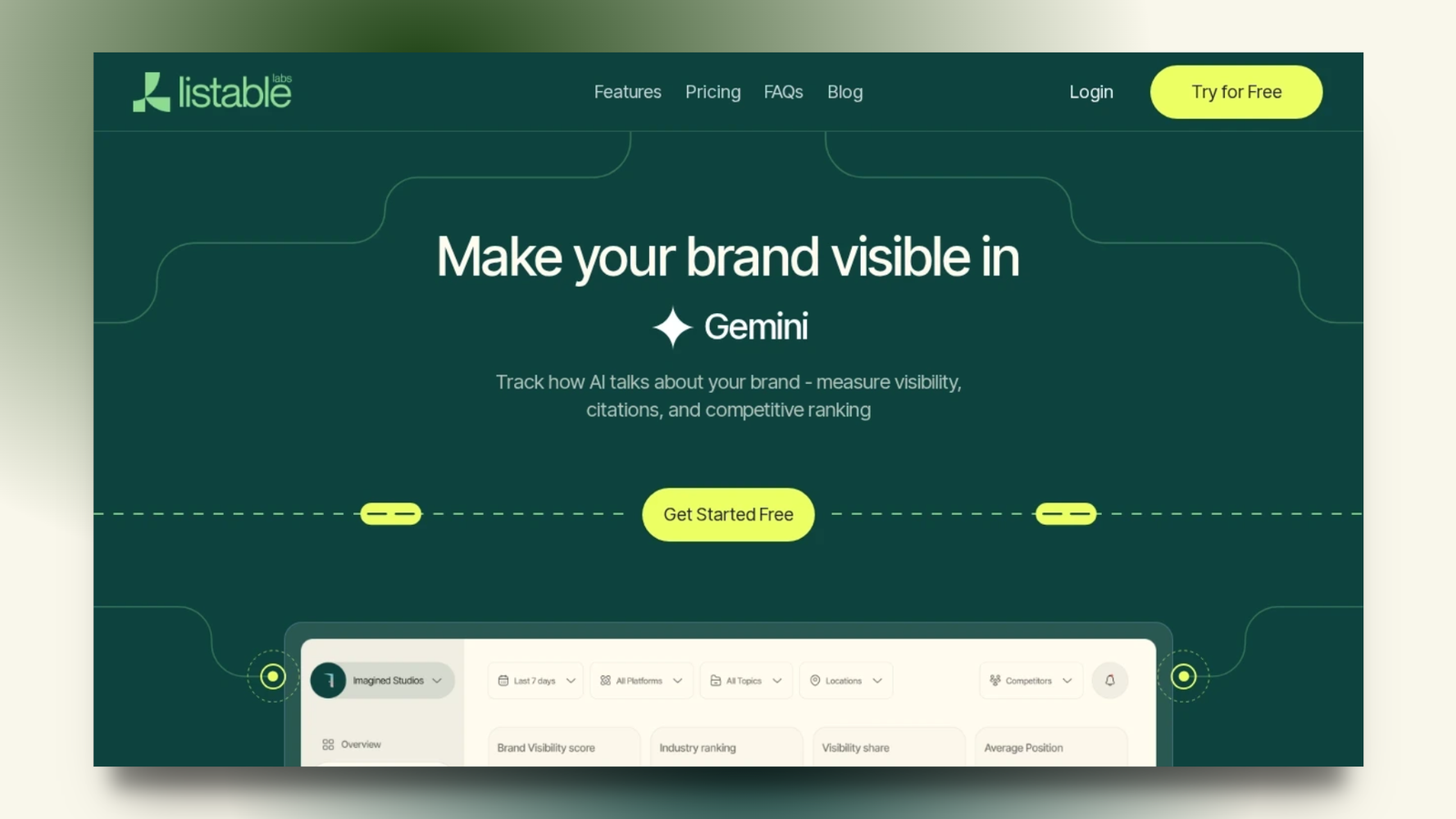
ChatGPT, Gemini and Google AI Mode are included on every plan. Perplexity, Google AI Overviews and Copilot are add-ons. Honest limits: Claude is not tracked, each plan includes 3 models, and Listable does not list Amazon Rufus or Alexa, so marketplace-assistant visibility needs a second tool. Growth is $89/month (50 prompts, 4,500 answers analysed, 10 articles, 2 seats). Scale at $249 adds 5 projects and white-label reports for agencies.
Best for: D2C brands and agencies managing several stores.
Starting at: from $89/month, free to start. See pricing.
2. Goodie AI: best for Amazon Rufus and agentic commerce
Verdict: the only tool here that lists Amazon Rufus and Alexa, built around revenue attribution.
Goodie Core is $399/month for 1 brand and 120 prompts, with MCP and unlimited seats. Its engine list includes ChatGPT, Gemini, Perplexity, Claude, AI Overviews, AI Mode, Copilot, Grok, Meta AI, Rufus and Alexa, and it markets SKU-level, agentic-commerce visibility. Pro is $999. The price keeps it out of reach for most early-stage D2C teams.
Best for: marketplace-heavy brands that need Rufus data and attribution.
Starting at: from $399/month.
3. Promptwatch: best for shopping insights and content agents
Verdict: broad model coverage with shopping insights on the top plan.
Promptwatch Essential is $95/month for 1 project, 4 models, 50 prompts and 6,000 responses. The $579 Business plan adds shopping insights, state and city tracking and an ads radar. It lists ChatGPT, Perplexity, AI Overviews, AI Mode, Claude and Gemini among its engines. The shopping features sit well above the entry price.
Best for: teams that want tracking plus content agents.
Starting at: from $95/month.
4. Rankscale AI: best credit-based tracker with shopping cards
Verdict: flexible credits and shopping-card analytics for ChatGPT, AI Mode and Copilot.
Rankscale Pro is $99/month for 1,200 credits (about 0.25 credit per AI-engine query) and 10 brand slots, with a 7-day free trial. It covers ChatGPT, Perplexity, AI Mode, AI Overviews, Gemini, Claude, Copilot, Grok, DeepSeek and Mistral. Credits roll over, which suits seasonal catalogues with launch spikes.
Best for: agencies with several stores and uneven prompt volume.
Starting at: from $99/month.
5. Cognizo: best for AEO content on autopilot
Verdict: pricing is anchored on content volume, with ChatGPT Shopping only on Pro.
Cognizo Growth is $499/month for 150 prompts, 5 platforms and 8 articles with auto-publishing. Pro is $999 for 350 prompts and 20 articles and adds ChatGPT Shopping and an AI ads library. Claude, AI Mode and Meta AI need Enterprise. It is expensive for a single-store brand.
Best for: brands that want content production built in.
Starting at: from $499/month.
6. Writesonic GEO: best for SEO and GEO with a writer
Verdict: useful if product copy and tracking should live in one tool.
Writesonic Starter is $79/month billed annually for 50 prompts on ChatGPT, Gemini and AI Overviews, plus 15 articles and 10 site audits. Shopping and agentic commerce features are Enterprise-only, and Perplexity and Claude are not on self-serve plans.
Best for: content-led stores.
Starting at: from $79/month, billed annually.
7. GetMint: best for EU and French D2C
Verdict: AI Shopping coverage including Amazon and Alexa, priced in euros.
GetMint Starter is EUR 74/month for 50 prompts, 2 topics and 2 AI models, with a GEO agent and daily refresh. It tracks ChatGPT, Gemini, Perplexity, AI Overviews and AI Shopping including Amazon and Alexa. Starter limits models to two, and Growth at EUR 299 raises that to three.
Best for: French and EU growing brands.
Starting at: from EUR 74/month.
8. Peec AI: best pure monitor for SEO-led stores
Verdict: clean daily tracking, three models per plan, no shopping surfaces.
Peec AI Starter is $95/month for 50 prompts, 3 models and unlimited users. Pro is $245 for 150 prompts. Models include ChatGPT, AI Mode, AI Overviews, Gemini, Perplexity and Claude. Extra models cost $30/month on Starter.
Best for: SEO teams with a content process already in place.
Starting at: from $95/month.
9. Otterly.ai: best budget start for a small store
Verdict: cheapest way to test whether AI search matters in your category.
Otterly Lite is $29/month for 15 prompts across ChatGPT, AI Overviews, Perplexity and Copilot. Gemini, Claude and AI Mode are paid add-ons. Fifteen prompts is a pilot, not a catalogue-wide programme.
Best for: small stores validating demand.
Starting at: from $29/month.
10. Gauge: best for challenger brands wanting volume
Verdict: 600 prompts run daily on one flat plan.
Gauge Growth is $599/month for 600 daily prompts, 108,000 answers a month, 18 articles and 5 seats, with a 1-week trial. It covers ChatGPT, AI Overviews, AI Mode, Gemini, Perplexity and Copilot, with Claude and Grok via your own API key. It publishes to Webflow, Framer, Sanity and GitHub, and is priced for larger catalogues.
Best for: challenger brands with many categories.
Starting at: from $599/month.
11. Bluefish AI: best for large enterprise commerce
Verdict: Fortune 500 focus, "Alexa for Shopping" tracked, no public price.
Bluefish sells through demos only and lists 10+ LLMs including Alexa for Shopping. Pricing is custom. The real site is bluefishai.com.
Best for: very large retailers.
Starting at: custom pricing.
12. Profound: best enterprise monitor
Verdict: up to 9 engines and enterprise controls, with a 7-day free trial.
Profound tracks ChatGPT, Perplexity, AI Mode, Gemini, Copilot, DeepSeek, Claude, AI Overviews and Exa on its Enterprise plan. Pricing beyond the trial is custom enterprise pricing.
Best for: national retail and marketplace brands.
Starting at: custom enterprise pricing.
13. Ahrefs Brand Radar: best for category benchmarking
Verdict: useful if your team already pays for Ahrefs.
Brand Radar covers AI Overviews, AI Mode, ChatGPT, Perplexity, Gemini and Copilot. Custom prompts start at $50/month for 2,500 checks, and the AI Visibility Index from $199/month draws on a 462M+ prompt database.
Best for: SEO teams benchmarking categories.
Starting at: from $50/month.
14. Paprik AI: best India-based low-cost option
Verdict: cheap entry from an India vendor, with tight limits.
Paprik Solo is $49/month billed annually for 1 brand, 20 prompts and ChatGPT only. Pro is $199 for 100 prompts and any 3 of 7 platforms. Both come with a 7-day free trial, no credit card.
Best for: early-stage Indian founders.
Starting at: from $49/month, billed annually.
15. AI Clicks: best for small teams wanting managed help
Verdict: 11 engines and managed services, with a short trial.
AI Clicks Starter is $59/month for 30 prompts, a choice of 3 LLMs and 5 articles. Pro is $189 for 150 prompts. The trial is 3 days. Use aiclicks.io, not the parked aiclicks.com.
Best for: small teams that want hands-on services.
Starting at: from $59/month.
What should India D2C brands and US ecommerce brands do differently?
India D2C brands should track India-location prompts, including price-led and festive-season queries, and note that marketplace and review listings can decide the shortlist. Tools with multi-country tracking let you compare India and US prompts side by side.
US ecommerce brands face more competition on retail and review citations, and Amazon-assistant visibility matters more. That is where Goodie AI or GetMint-style shopping coverage can justify its price.
Either way, publish product facts once in a knowledge base, then reuse them across pages.
How to choose an AEO tool for your store
- Start with 40 to 50 prompts: category, comparison, use-case, price-band and branded.
- Check shopping surfaces: if Rufus or ChatGPT Shopping matters, confirm they are covered and at which plan.
- Look for CMS fit: Shopify, WordPress and Webflow integrations save publishing time.
- Demand citation data: you need to see which marketplaces and review sites are cited.
- Match budget to catalogue: a 15-prompt plan cannot cover ten product categories.
- Test crawl access: run the free AI Crawlability Checker on your store first.
Final verdict: which tool should your store choose?
Choose Listable Labs if you want ChatGPT, Gemini and AI Mode tracking, Shopify publishing and India plus US coverage from $89/month. Add Goodie AI if Amazon Rufus is central, and start with Otterly.ai if you only need a pilot. For more comparisons, read our guides to leading AEO platforms and AEO tools ranked by value. Agencies running several stores can book an agency demo.
Frequently Asked Questions
Related Articles
15 Best AEO & GEO Tools for AI Search Visibility (2026)
The best GEO tools of 2026, ranked: 15 generative engine optimization platforms with checked prices, engine coverage and honest limits, plus a plain explanation of GEO vs AEO vs SEO.
Best AI Search Visibility Tools 2026 Pricing and Coverage
A price-and-coverage comparison of 18 AI search visibility tools: starting price, engines tracked, prompt limits and the plan caps that change the real cost.
Semrush and Ahrefs AI Visibility vs Dedicated AEO Tools: What We Found After Real Testing (2026)
When is a Semrush or Ahrefs AI-visibility feature enough, and when is a dedicated AEO tool like Listable Labs, Peec or Profound the better buy? Our 2026 testing breaks it down.