8 Best LLM Rank Trackers: ChatGPT, Gemini, and Perplexity
 Kalgi Sheth
TL;DR: the best LLM rank tracker in 2026
Listable Labs is the best LLM rank tracker for most teams in 2026: it tracks ChatGPT, Google Gemini and Google AI Mode from $89/month, shows which sources each answer cites, and turns the gaps into content fixes. Peec AI is the best pure monitor, Profound suits enterprises, and Otterly.ai is the cheapest start at $29/month.
An LLM rank tracker is software that runs your buyer prompts through ChatGPT, Gemini, Perplexity and other AI engines, then records whether your brand is mentioned, where, and which sources the answer cites. Prices and engine lists below were checked on vendor pricing pages in October 2026.
| Tool | Starting price | Engines | Best for |
| Listable Labs | $89/mo (50 prompts) | ChatGPT, Gemini, AI Mode + add-ons | Tracking plus content actions |
| Peec AI | $95/mo (50 prompts) | 3 models on plan, up to 13 on Enterprise | Clean monitoring for SEO teams |
| Promptwatch | $95/mo (50 prompts) | 4 models on plan | Tracking with AEO content agents |
| Profound | Free 7-day trial, then custom | Up to 9 engines | Enterprise programmes |
| Semrush | $199/mo (50 prompts daily) | 5 engines | Teams already on Semrush |
| Otterly.ai | $29/mo (15 prompts) | 4 engines, 3 add-ons | Budget monitoring |
| Rankscale AI | $99/mo (1,200 credits) | 10 engines | Unlimited search terms |
| LLMrefs | Free account, then $79/mo | 11 engines | Keyword-based share of voice |
What does an LLM rank tracker actually measure?
There is no fixed "rank one" in a ChatGPT answer, so these tools report rates. The core metrics are mention rate (the share of runs that name your brand), citation rate (the share that link to your pages), average position inside the answer, and share of voice against named competitors.
Because the same prompt can return different brands on different runs, a single check proves nothing. Good trackers repeat each prompt on a schedule and report the average. That is also why the prompt count in a plan matters more than a long feature list.
How we ranked these LLM rank trackers
This list is for marketers and SEOs choosing a tool to measure visibility in ChatGPT, Gemini and Perplexity. We scored each tool on five points:
- Engine coverage: which engines sit in the base price and which are paid add-ons.
- Prompts per dollar: how many tracked prompts and analysed answers you get at the entry tier.
- Citation data: whether you can see the source URLs behind each answer, not only a mention count.
- Actions, not only monitoring: whether the tool helps you fix gaps or only reports them.
- Reporting and fit: client reporting, integrations and whether pricing suits India and US teams.
We placed Listable Labs first because it is our product, and we say so plainly. Where it falls short, we say that too.
1. Listable Labs: best LLM rank tracker for tracking plus action
Verdict: the strongest pick when you want to find visibility gaps and fix them in one workflow.
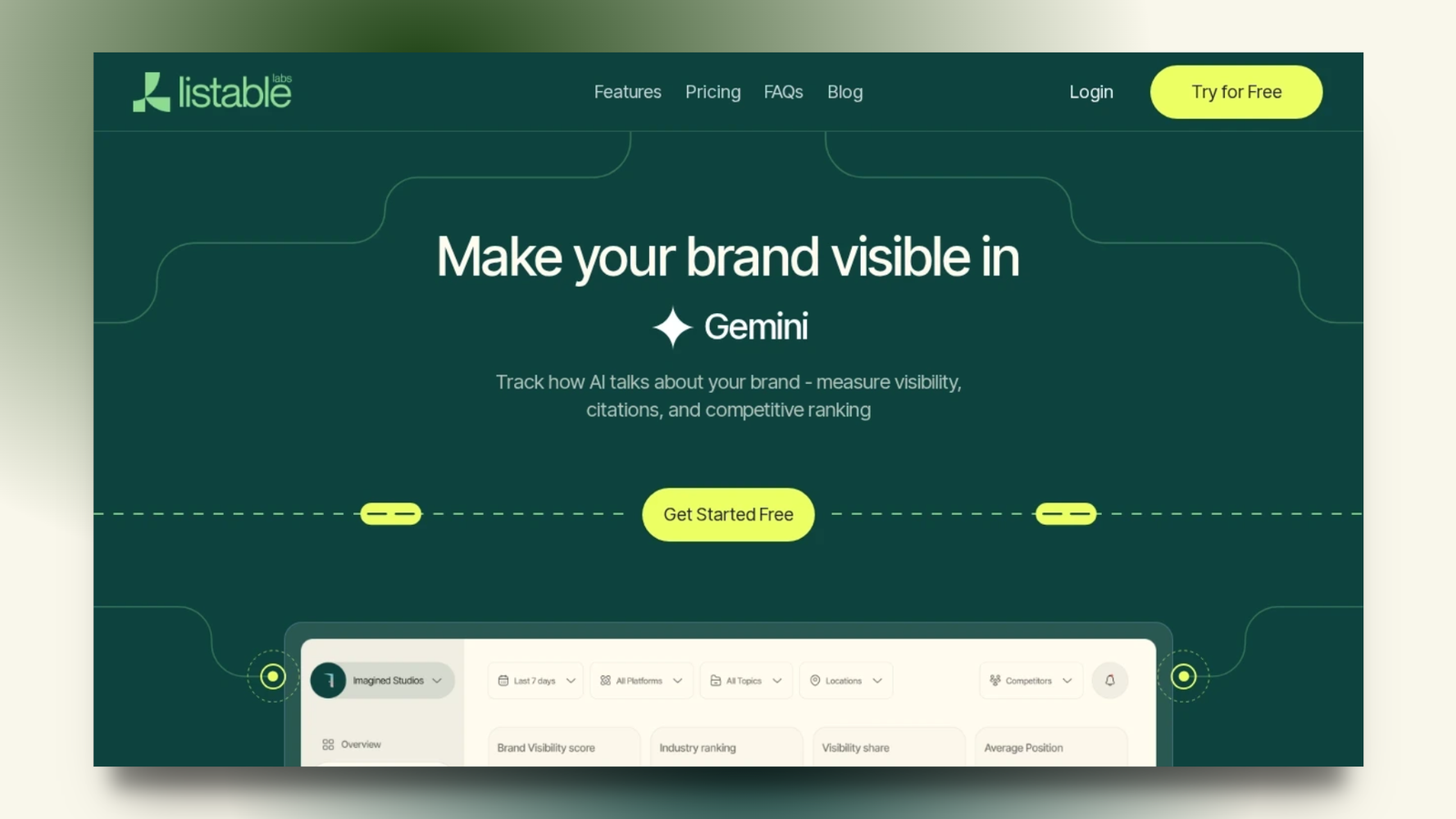
Listable Labs is an AI search visibility and AEO platform built in Bengaluru and used by brands in India, the US and beyond. It follows an Insights, Actions, Impact loop. Insights covers visibility score, mentions, citations, share of voice and competitor benchmarks. Actions covers the Prompt Explorer, a knowledge base, AI-optimised article generation with review steps, and social content for Reddit, LinkedIn, YouTube and Instagram. Impact ties it to traffic through Google Analytics, Google Search Console, Bing Webmaster Tools and Cloudflare.
ChatGPT, Google Gemini and Google AI Mode are included on every plan. Citation Intelligence shows the pages the engines lean on, which is the data that tells you where to publish or earn a mention. The Listable Labs MCP lets you query visibility, mentions, citations and competitors from Claude, ChatGPT, Cursor and other MCP clients.
Limitations are real. Perplexity, Google AI Overviews and Microsoft Copilot are paid add-ons, and the base plans include 3 models. Claude, Grok, Meta AI and DeepSeek are not tracked. If your buyers live mostly in those engines, add a wider monitor.
Best for: marketing teams and agencies that want tracking and execution together.
Starting at: $89/month (Growth: 1 project, 50 prompts, 4,500 AI answers, 10 articles). Scale at $249/month adds 5 projects, 200 prompts and white-label reports. You can start free with no credit card.
2. Peec AI: best pure LLM monitor
Verdict: a clean, fast dashboard for teams that only want measurement.
Peec AI tracks mentions, positions and sources across prompts and countries, with unlimited users on every plan. Engine coverage is broad on paper (ChatGPT, AI Mode, AI Overviews, Gemini, Perplexity, Claude, Grok, DeepSeek, Mistral and Meta), but self-serve plans cap you at 3 models and charge extra for each additional model. That makes the real price higher if you need more than three engines.
It does not write or publish content, so pair it with a content workflow.
Best for: SEO teams and GEO agencies that want dashboards and country-level views.
Starting at: $95/month (Starter: 50 prompts, 3 models, 1 project). Pro is $245/month and Advanced is $495/month.
3. Promptwatch: best for tracking with content agents
Verdict: good value at 50 prompts, with more engines in the base price than Peec.
Promptwatch includes 4 models and 6,000 responses on its $95 Essential plan, adds country-level tracking, and bundles MCP and API access. It also offers content agents and tracks coding agents such as Claude Code. Data is collected by scraping the consumer interfaces of AI engines rather than their APIs, which is closer to what real users see.
Prompt limits climb quickly: 150 prompts means the $245 Professional plan.
Best for: teams that want 4 engines and content help at an entry price.
Starting at: $95/month.
4. Profound: best enterprise LLM rank tracker
Verdict: the heavyweight option, priced for large programmes.
Profound covers up to 9 answer engines, including ChatGPT, Perplexity, AI Mode, Gemini, Copilot, DeepSeek, Claude and AI Overviews. Enterprise features include API access, SSO and SOC 2, plus Agent Analytics that read CDN and log data. It uses custom enterprise pricing, and the free trial is limited: 7 days, 50 prompts a day across ChatGPT, Gemini and AI Overviews, with fixed prompts you cannot customise.
For a small team the cost and sales cycle are hard to justify.
Best for: enterprise AEO teams with security and procurement requirements.
Starting at: free 7-day trial, then custom pricing.
5. Semrush: best if you already live in Semrush
Verdict: convenient when AI visibility must sit beside SEO reporting.
Semrush tracks ChatGPT, Perplexity, Gemini, AI Mode and AI Overviews. The old standalone AI Visibility Toolkit page now returns a 404, because AI visibility has been folded into the SEO plus AI Search bundles. The $139 SEO plan has limited AI features, and the Starter bundle at $199/month tracks 50 prompts daily for one domain.
It costs more per prompt than AI-first tools, but the rest of the suite comes with it.
Best for: existing Semrush teams that want one login.
Starting at: $199/month for the AI Search Starter bundle.
6. Otterly.ai: best budget LLM rank tracker
Verdict: the cheapest serious way to start tracking.
Otterly.ai's Lite plan costs $29/month for 15 prompts across ChatGPT, AI Overviews, Perplexity and Copilot. Gemini, Claude and AI Mode are paid add-ons. Fifteen prompts is a pilot, not a programme, and scaling is expensive: Standard is $189/month for 100 prompts and Premium is $489/month for 400.
Best for: small teams proving the channel before committing budget.
Starting at: $29/month.
7. Rankscale AI: best for credit-based flexibility
Verdict: unlimited search terms, with cost set by credits.
Rankscale's Pro plan is $99/month for 1,200 credits, where roughly a quarter of a credit buys one AI-engine query. It covers 10 engines, including ChatGPT, Perplexity, AI Mode, AI Overviews, Gemini, DeepSeek, Mistral, Claude, Copilot and Grok, and it offers a 7-day free trial. The credit model rewards careful prompt design but makes monthly cost harder to forecast.
Best for: analysts who want many terms and control over refresh frequency.
Starting at: $99/month.
8. LLMrefs: best for keyword-based share of voice
Verdict: the widest engine list for the least money.
LLMrefs tracks keywords and generates the fan-out prompts itself, covering ChatGPT, ChatGPT Search, AI Overviews, AI Mode, Gemini, Perplexity, Claude, Grok, Copilot, Meta AI and DeepSeek. One flat plan includes 500 prompts, unlimited projects and team members, and a CSV export and API. Results refresh weekly rather than daily, so it suits trend tracking more than daily alerting.
Best for: SEOs and agencies who think in keywords and want broad coverage cheaply.
Starting at: free account, then $79/month.
Other LLM rank trackers worth a look
- ZipTie: usage-based pricing at about $0.01 per prompt per engine per daily check, with a free 7-day trial and API plus MCP access.
- Trakkr: $100/month for 50 prompts across all 8 of its models, with a 14-day trial.
- Ahrefs Brand Radar: from $50/month for 2,500 checks, strong if you already use Ahrefs.
- SE Ranking (SE Visible): $129/month Core with 100 prompts a day and a 14-day trial.
- Knowatoa: $59/month, weekly refresh, aimed at small B2B SaaS.
- Cairrot: $39/month for 15 prompts and 2 LLMs.
How to choose an LLM rank tracker
- Check which engines are in the base price. Add-ons for Perplexity, Gemini or AI Mode can double the real cost.
- Count prompts, not features. Start with 40 to 50 buyer prompts; fewer than 15 swings too much to guide decisions.
- Demand source URLs. A mention count with no citations tells you where you stand but not how to move.
- Decide if you need actions. If your team cannot turn gaps into content, choose a tool that writes and publishes.
- Plan for reporting. Agencies should compare client workspaces and white-label options. See our guide to LLM rank trackers for SEO agencies.
- Test before paying. Use the free routes in our roundup of free LLM rank tracker tools.
LLM rank trackers vs keyword rank trackers
A keyword tracker gives you one position for one URL. An LLM tracker gives you a rate: how often your brand appears across repeated runs of the same prompt, because AI answers vary. If you want the side-by-side, read AI rank trackers vs keyword rank trackers. You can also check whether AI crawlers can reach your site with the free AI Crawlability Checker.
Final verdict
Pick Listable Labs if you want one tool to find visibility gaps and act on them, Peec AI or LLMrefs if you only need measurement, Otterly.ai to start cheaply, and Profound if procurement demands an enterprise contract. If you want a team to run it for you, the managed AEO service starts with a free discovery audit, and self-serve users can start free on Listable Labs with no credit card.
Frequently Asked Questions
Related Articles
How Companies Get Brands Surfaced by Generative AI Engines
A practical 2026 playbook for getting your brand recommended by ChatGPT and other AI engines: fix your facts, win the sources engines read, publish answer-ready pages and measure the result.
7 Best Brand AI Visibility Tracking Tools in 2026
The 7 best AI brand visibility tracking tools for 2026, ranked with verified October 2026 pricing, plus 5 more we compared. Engines, prompt limits, citation data and who each one suits.